At a glance
15%
HST on a commercial sale in this province
29.5 mills
2026 commercial rate with water and sewer
4 zones
CM, CK, CN and CL, each with its own permitted uses
No history
The site holds no commercial transaction data
Jump to a section
Most surprises in commercial property come from four places: tax, zoning, the lease and financing. Each can be checked before you sign.
This guide covers all four, then gives a due diligence checklist and a plain translation of the clauses in a commercial lease. It does not quote cap rates, vacancy rates or interest rates, because those are stale by the time you read them. If you are comparing space, start with the commercial listings and the lease page.
One thing first. This site's property database tracks residential transactions: single-family, two-apartment, condominium, mobile and small multi-family homes across St. John's, Mount Pearl, Paradise and Conception Bay South. It contains no commercial sales, so there is no local commercial transaction history behind this article and none is claimed. What follows is market context, regulatory detail and financing guidance from official sources.
1. HST, and the cash-flow shock it creates
Residential resale is usually exempt from HST. Commercial property usually is not. The CRA is direct: a sale of commercial real property "is generally a taxable supply whether the property is new or used, unlike sales of used residential complexes which are generally exempt." CRA: Commercial Real Property, Sales and Rentals
The rate here is 15%: 5% federal GST and a 10% provincial portion, which rose from 8% on July 1, 2016. Government of Newfoundland and Labrador: Harmonized Sales Tax The CRA rate table confirms 15% for this province from April 1, 2025 onward. CRA: GST/HST rates
Two mechanics decide whether that is a recoverable cost or a permanent one. If you are a GST/HST registrant buying for a commercial activity, you may be able to claim an input tax credit, recovering much of the tax; if you are not registered, or the property is for personal use, that recovery is unavailable. Where the purchaser is registered, the supplier need not collect the tax and the purchaser self-assesses and remits it. CRA That is a timing and paperwork obligation on you, not the seller.
An illustration, with round numbers, not a quote:
| Line | Amount |
|---|---|
| Purchase price | $500,000 |
| HST at 15% | $75,000 |
| Total consideration | $575,000 |
| Input tax credit, if eligible | Up to $75,000 |
If the credit is available, the $75,000 returns through your GST/HST return, but you still fund it at closing. That gap leaves undercapitalised buyers short. Confirm your position with your accountant before removing conditions.
2. Zoning: check the parcel, not the neighbourhood
St. John's has no separate commercial zoning by-law. Commercial zones form part of the Envision St. John's Development Regulations, and each carries its own list of permitted, discretionary and prohibited uses. City of St. John's: Envision St. John's Municipal Plan
The zones you will meet most often, with permitted uses from the current edition:
| Zone | Name | Some permitted uses |
|---|---|---|
| CM | Commercial Mixed Use | Bank, office, restaurant, retail, service shop, hotel, child care, clinic |
| CK | Commercial Kenmount | Shopping centre, retail, restaurant, office, bank, hotel, funeral home, service station, warehouse |
| CN | Commercial Neighbourhood | Convenience store, clinic, office, retail, service shop |
| CL | Commercial Local | Retail, convenience store, office, clinic, laundromat, library |
Source: Envision St. John's Development Regulations
Three things follow. "Commercial" is not one thing: a warehouse is permitted in CK but not on the CM list, and a use that is fine in one commercial zone can be prohibited two blocks away. Permitted and discretionary also differ, because a restaurant is permitted in CM but sits on the CN discretionary list, meaning Council's judgement and usually a public process. And zones carry dimensional standards: CK requires a minimum lot area of 1,800 square metres, frontage of 45 metres, maximum height of 18 metres, lot coverage of 50% and landscaping of 20%, while CM leaves most standards to Council's discretion. Those standards decide whether your operation fits the parcel.
To check a property, use MapCentre, which shows land use zones, development regulations, floodplains, wetlands and heritage areas for a searched address. City of St. John's: Maps Then read the zone schedule. If your use is discretionary, ask planning before committing: planning@stjohns.ca or 709-576-8220.
3. Buying versus leasing
The decision is less about monthly cost than about how long you stay, how much capital you tie up and how much control you need.
| Buying | Leasing | |
|---|---|---|
| Upfront | Down payment, HST timing, legal, due diligence | Deposit, first month, tenant fit-up |
| Monthly | Principal, interest, tax, insurance, maintenance, reserves | Rent plus whatever the lease passes through |
| Control | Full, subject to zoning and by-laws | Limited by the lease and landlord |
| Exit | Sell the building | Assign or sublet, subject to the lease |
| Risk | Condition, environmental history, market value | Rent escalation, renewal terms, landlord decisions |
Property tax is the line first-time commercial buyers underestimate. For 2026 the commercial rate is 29.5 mills with water and sewer against 9.1 mills residential, commercial water tax is $700, and Business Improvement Area properties add 0.8 of a mill. City of St. John's: tax rates On $500,000 assessed, that is $14,750 before water against $4,550 residential. A building that looks affordable can be unaffordable to hold.
4. What a commercial lease clause actually means
A commercial lease is a negotiated contract, not a standard form, and the Residential Tenancies Act does not apply: the government's FAQ states the Act "does not apply to a commercial landlord-tenant relationship or to a premises that is used for a business purpose." Government of Newfoundland and Labrador: Landlord and Tenant FAQ
Base rent. Usually quoted per square foot per year. A $28 rate on 1,500 square feet is $42,000 a year, or $3,500 a month, before anything else. Convert every quote to a monthly figure before comparing.
Additional rent, gross versus net. In a gross lease you pay one amount and the landlord covers operating costs. In a net lease you pay base rent plus some costs. In a triple net lease you typically pay base rent plus property taxes, building insurance and utilities, plus other operating and maintenance costs, with the landlord responsible mainly for structural repairs; a double net lease usually means base rent plus taxes and insurance. BDC: 13 commercial leasing terms Occupancy cost is not the rent on the sign, so ask for actual additional rent for the last two or three years in writing.
Common area maintenance. Your share of snow clearing, landscaping, parking lot repair, lighting and management. Ask what the pool includes, how your share is calculated, and whether controllable costs are capped.
Term and renewal options. A five year term with two five year options is not a ten year lease. An option is a right at a rent the lease defines, so if the lease is silent on how renewal rent is set, the option is worth far less than it appears. Negotiate the mechanism, not just the option. A tenant improvement allowance, the landlord's contribution to the fit-out, is usually per square foot and tied to approved plans and a deadline. Get the scope, amount, schedule and ownership in writing.
Who owns the improvements. Unless the lease says otherwise, an improvement attached to the building usually becomes the landlord's property, so you cannot take it when you leave. BDC If you are installing a kitchen, racking or specialized equipment, negotiate a removal right for those.
Assignment and subletting. Whether you can transfer the lease if the business changes. Most leases require consent and allow a review fee. If your exit depends on assignment, negotiate the standard now.
Personal guarantee. Landlords often require the principal to guarantee rent personally, turning a business failure into a personal liability. Ask whether it can be capped, time limited, or reduced after a payment track record.
Repairs and maintenance. Who fixes the roof, the HVAC, the parking lot and the structure. A lease that puts those on the tenant makes a cheap rent expensive. Get the split in writing.
Insurance, restoration, holdover and default. Check what you must insure, whether you must restore the premises after a fire at your own cost, what happens if you stay past the term, and what triggers default. A short cure period turns a minor administrative miss into a termination right.
Have a lawyer who practises in commercial leasing review the lease before you sign. These explanations are orientation, so you know what to ask.
5. Due diligence checklist for a commercial purchase
| Area | What to obtain | Where it comes from |
|---|---|---|
| Zoning | The parcel's zone, plus permitted and discretionary uses | MapCentre, Development Regulations |
| Compliance | Whether the current use is permitted, or non-conforming | City planning, 709-576-8220 |
| Permits | Building permits, occupancy certificates, open permits | City permit counter, 709-576-8565 |
| Condition | Assessment of structure, envelope, roof, mechanical, electrical | Your own consultant |
| Environmental | Phase I site assessment, and Phase II if recommended | A qualified environmental consultant |
| Provincial records | A property environmental search | Impacted Sites, impactedsites@gov.nl.ca |
| Title | Title search, survey, easements, rights of way, encumbrances | Your lawyer |
| Tenancies | Leases, amendments, rent roll, arrears history, deposits | The seller, verified against the leases |
| Tenant estoppels | Tenant confirmation of terms, rent, deposits, claims | Through the seller |
| Operating history | Three years of statements, tax bills, utilities, maintenance | The seller, with right to verify |
| Tax and financing | HST treatment; a written loan commitment | Accountant and lender |
Two deserve more detail.
Environmental history. For a property that has housed a fuel tank, a garage, a dry cleaner, a workshop or industrial processes, this is not optional. In this province, assessment and remediation is done by a Site Professional under the provincial Guidance Document for the Management of Impacted Sites, and a Record of Site Condition is submitted for regulatory closure and reviewed by the Impacted Sites Management Section. Government of Newfoundland and Labrador: Impacted Sites Management That section also runs property environmental searches of departmental files for purchasers, consultants, lawyers and REALTORS®.
Tenant estoppels. If you are buying a leased building, the seller's rent roll is a claim, not a fact. An estoppel certificate is the tenant's own confirmation of terms and of any claims or defences. A tenant who will not sign one is information, and it belongs in your price.
6. How commercial financing differs
Commercial mortgages generally carry lower loan-to-value ratios than residential mortgages and shorter amortization periods, meaning a higher down payment and faster repayment. BDC: What is a commercial mortgage BDC describes a starting loan-to-value of 85% and states commercial mortgages are usually amortized over 20 years or less. Its worked scenario, a $500,000 property with 20% down and a $400,000 mortgage at a hypothetical 5% over 20 years, produces $2,639.82 a month. That is BDC's illustration, not a current rate.
The bigger difference is what the lender underwrites. Residential lending underwrites your income. Commercial lending also underwrites the building: its income, tenants, leases and condition. A strong personal balance sheet does not rescue a building with no income and no viable use.
Expect the lender to want financial statements for the business and principals, a business plan, leases if tenanted, a condition assessment, environmental reports where relevant, a valuation, and proof of down payment and of the ability to cover overruns. CMHC Improvement
Ask your lender, before you shop:
- What loan-to-value will you offer here, and does it change for owner-occupied versus tenanted?
- What amortization, and is there a balloon payment?
- What is the term, and what happens at renewal?
- Which income will you count, and what proof do you need?
- What conditions, and how long to satisfy them?
- What is the penalty for early payout?
That last one matters. A long term with a rate-differential prepayment penalty can be expensive to exit.
7. Buying a business rather than a building
A business purchase carries different risks, even when a building is part of it.
- What is being sold, shares or assets? The tax and liability consequences differ completely, and only your accountant can say which suits you.
- Can the trading history be verified from source documents rather than summary statements?
- Are there CRA arrears? Ask for the seller's statements of account and recent filings. A clearance certificate is generally issued for estates, trusts and corporations winding up, not going-concern purchases, so your protections are contractual: warranties, indemnities and a holdback. CRA: Apply for a clearance certificate
- Are licences, permits and registrations transferable, or must you apply fresh?
- Is the entity in good standing? Search it through the province's Companies and Deeds Online service. CADO company search
- Do key employees stay, and are customer contracts assignable?
- Does the lease transfer, and must the landlord consent?
If the business operates from leased premises, the lease is part of the deal. A strong customer base with two years left and no renewal option is a business with an expiry date.
Questions buyers and tenants ask
Is HST charged on commercial property in St. John's?
Generally yes, at 15%, whether new or used, because a sale of commercial real property is taxable unless a specific exemption applies. CRA Whether you can recover it depends on your registration and use, so confirm with your accountant.
Do I need a lawyer to review a commercial lease?
Practically, yes. The Residential Tenancies Act does not apply to commercial tenancies, so the lease terms are your only protection. Government of Newfoundland and Labrador
How much down payment does a commercial mortgage need?
It varies by lender, property and borrower. BDC describes a starting loan-to-value of 85%, which implies 15% down, and notes commercial mortgages typically require 20% to 35%. BDC Get a written commitment, not a rule of thumb.
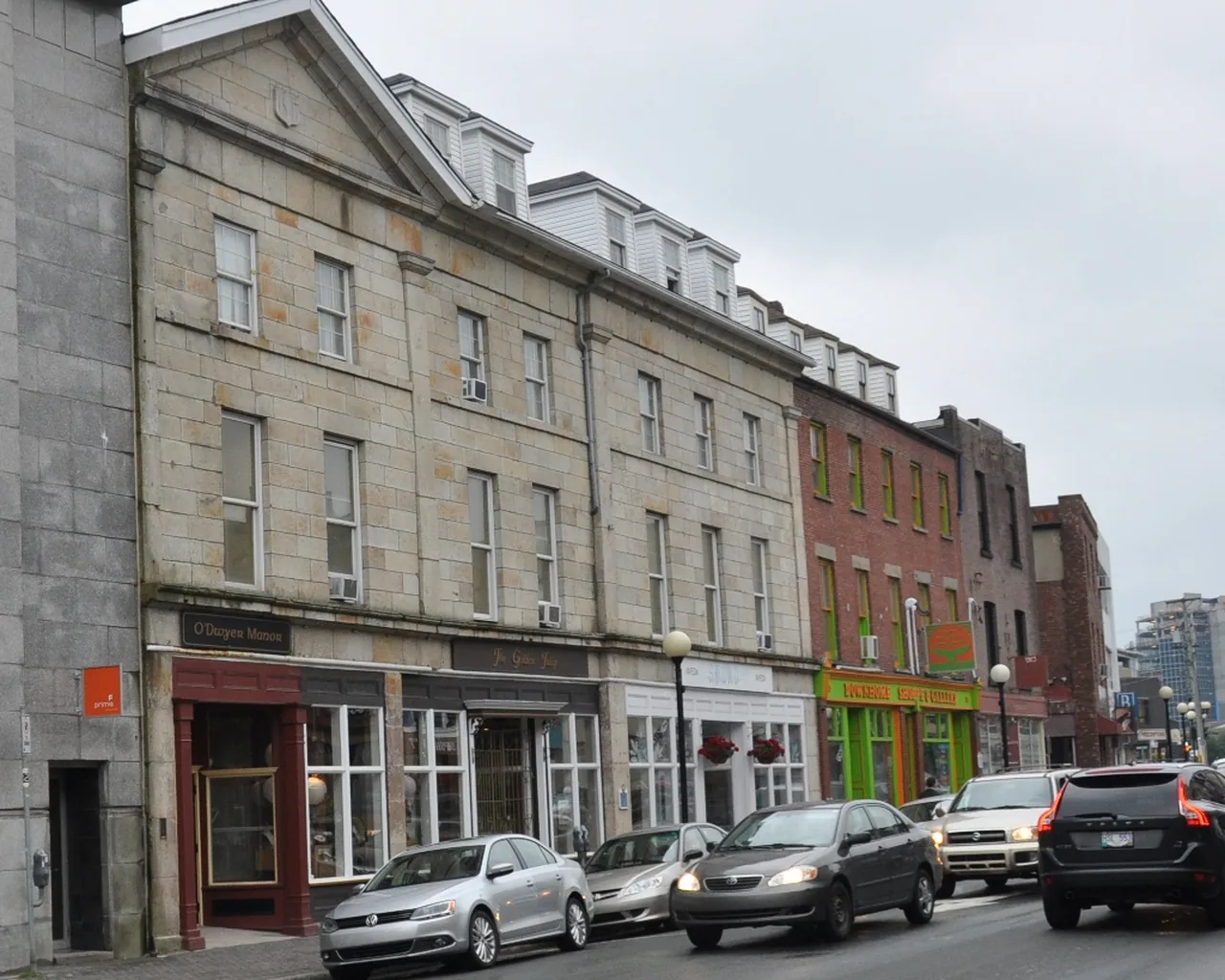
Photo: Water Street, St. John's by Magicpiano, via Wikimedia Commons, licensed under CC BY-SA 3.0. Cropped and resized.
Sources
Official references checked November 1, 2026. Confirm what applies to your property with your lender, lawyer or municipality.
- CRA: Commercial Real Property, Sales and Rentals
- Government of Newfoundland and Labrador: Harmonized Sales Tax
- CRA: GST/HST rates
- City of St. John's: Envision St. John's Municipal Plan
- Envision St. John's Development Regulations
- City of St. John's: Maps
- City of St. John's: tax rates
- Government of Newfoundland and Labrador: Landlord and Tenant FAQ
- BDC: 13 commercial leasing terms
- Government of Newfoundland and Labrador: Impacted Sites Management
- BDC: What is a commercial mortgage
- CMHC Improvement
- CRA: Apply for a clearance certificate
- CADO company search
- Water Street, St. John's
- CC BY-SA 3.0